
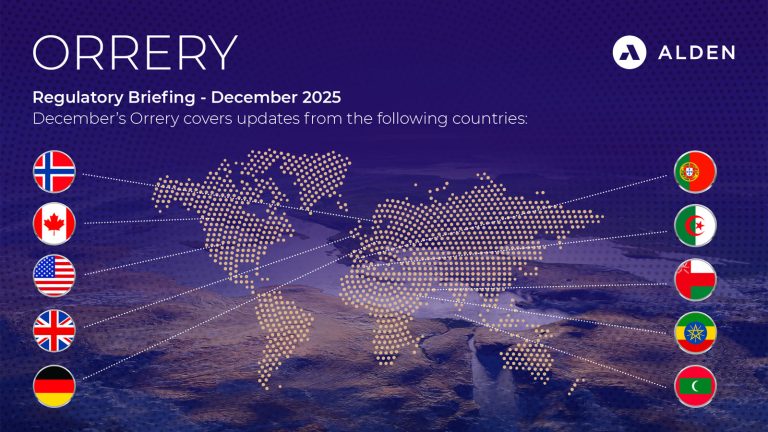
Alden Orrery – Regulatory Briefing – December 2025
EUROPE
United Kingdom
Ofcom finalises UK authorisation framework for satellite Direct-to-Device services
On 9 December 2025, Ofcom took decisive steps to finalise the authorisation framework enabling the use of spectrum bands held by the UK’s Mobile Network Operators (MNOs) for satellite Direct-to-Device (D2D) services in its “Enabling satellite Direct to Device services in Mobile spectrum bands; Final statement” (December Statement).
The December Statement follows Ofcom’s earlier consultations on establishing a spectrum authorisation framework for D2D services in commercial mobile bands, as well as the September 2025 Statement, which confirmed the regulator’s intention to implement an authorisation framework that requires a variation to an MNO’s existing licence and new exemption regulations that will enable end users to lawfully connect to D2D services.
In the December Statement, Ofcom confirmed their decisions to:
- introduce a condition requiring protection for 2.7-3.1 GHz radars, to be included in any 2.6 GHz licence D2D schedule;
- implement the proposed D2D licence conditions, with the addition of a coordination clause for any licence variation requests Ofcom may receive for operation in 2.6 GHz; and
- make the regulations relating to the licence exemption of mobile handsets that connect to a D2D satellite, following completion of a licence variation process
UK and Germany partner on quantum
On 5 December 2025, the UK and Germany announced plans to work more closely together to unlock the potential of quantum technology. As part of a wider package of science and technology agreements, the two countries confirmed £6 million in joint funding for quantum R&D, an £8 million investment in Fraunhofer UK’s applied photonics centre in Glasgow and a new agreement on shared approaches to quantum research standards. Building on a longstanding strategic partnership between the UK and Germany, this initiative is intended to deepen cross-border collaboration, support industrial R&D and promote greater alignment in emerging quantum regulation.
Orbit Fab awarded ESA contract for ASTRAL in-orbit refuelling mission
It was announced on 21 November 2025 that in-orbit logistics company Orbit Fab has been selected to deliver the Advancing Satcom Technology with Refuelling and Logistics (ASTRAL) project, supported by up to €3.3 million in funding. The contract for the first phase of the mission, valued at €1.1 million, has now been awarded to Orbit Fab through ESA’s Advanced Research in Telecommunications Systems (ARTES) Core Competitiveness programme.
ASTRAL will carry out an in-orbit demonstration by 2028 to de-risk and validate Orbit Fab’s RAFTI™ and GRASP refuelling interfaces in a realistic docking and propellant-transfer scenario. The ASTRAL mission will test the performance of these systems in operational conditions, representing a key step toward demonstrating the feasibility of sustainable satellite servicing and in-orbit refuelling.
Germany
Germany presents first National Space Safety and Security Strategy
On 19 November 2025, the German Government released its first Space Safety and Security Strategy, setting out how Germany intends to strengthen its ability to operate in space in close cooperation with partners in the EU, NATO and the wider international community.
The Strategy identifies the evolving risks and threats in the space domain and establishes three core areas of action:
- Identify risks and threats, develop options for action;
- Promote international cooperation and sustainable order in space; and
- Build deterrence, strengthen defence capabilities and resilience.
The Strategy also reaffirms Germany’s commitment to the peaceful, sustainable and rules-based use of space, with the aim of preventing an arms race and ensuring long-term stability in the space environment.
Norway
Norway to host ESA Arctic Space Centre
It was announced on 27 November 2025 that the European Space Agency (ESA) has signed a letter of intent with Norway to explore the prospect of a new ESA Arctic Space Centre, to be hosted in Tromsø, Norway.
Following the signature, ESA and Norway, through the Norwegian Space Agency (NOSA), will now form a joint working group for experts to examine the possibilities for the ESA Arctic Space Centre. Situated in a region acutely affected by climate change, the centre may be expected to focus on Earth observation, navigation and telecommunications, working with regional stakeholders to support climate monitoring and mitigation, as well as sustainable development, civil safety and security, and energy management across the Arctic.
The initiative reflects growing strategic interest in leveraging space capabilities to support environmental resilience and operational needs in the Arctic and Europe more broadly.
Portugal
ICEYE and the Portuguese Air Force announce first direct satellite procurement
On 2 December 2025, ICEYE, a global leader in Synthetic Aperture Radar (SAR) satellite operations, and the Portuguese Air Force announced an agreement for the direct procurement of an ICEYE SAR satellite. This marks the first time the Portuguese Air Force has directly acquired a satellite, representing a significant milestone in the development of Portugal’s sovereign space and defence capabilities.
The acquisition will enhance Portugal’s capacity for surveillance, situational awareness and national security operations. Direct satellite ownership will enable faster response to military requirements, maritime security needs, environmental monitoring and the protection of national interests, including Portugal’s Exclusive Economic Zone (EEZ) and its natural resources. The decision aligns with Portugal’s broader ambitions in space and defence modernisation.
AFRICA
Algeria
Algeria and China strengthen space cooperation
On 7 December 2025, Algeria Télécom Satellite and the Algeria Space Agency each signed memoranda of cooperation with China’s Geespace to advance Algeria’s ambitions in satellite Internet-of-Things (IoT) services, low Earth orbit (LEO) satellite manufacturing and broader space technology development.
Geespace’s expanding cooperation with Algeria forms part of a wider strategic partnership between the two countries. The memoranda signal Algeria’s intent to modernise its national space infrastructure, strengthen technological capacity and diversify the use of satellite capabilities across government and industry.
Ethiopia
Ethiopia Expands National Geospatial Infrastructure
On 4 December 2024, Ethiopia’s Space Science and Geospatial Institute (SSGI) unveiled a new network of satellite data collection stations in Addis Ababa and several key regional cities in Ethiopia, advancing the country’s digital transformation agenda and strengthening geospatial sovereignty.
SSGI has now brought ten Continuous Operating Reference Stations (CORS) into operational service, marking a significant milestone in the Digital Ethiopia 2025 Strategy. The CORS network enables real-time reception and processing of satellite data, providing uninterrupted geospatial services. The high-quality data produced is already supporting urban planning, infrastructure development, disaster preparedness and other national priority applications.
NORTH AMERICA
United States
LeoLabs awarded inter-agency US contract for Object Catalog access
On 9 December 2025, LeoLabs, a leading provider of orbital surveillance data, announced that it has been awarded a contract by the United States (US) Department of Commerce (DOC), Office of Space Commerce (OSC) and the US Space Force (USSF) Joint Commercial Operations Cell (JCO) to license access to its “Object Catalog”.
The contract, awarded on 30 September 2025, marks the first coordinated procurement across multiple US government agencies to utilise the commercial space surveillance data of LeoLabs at scale, supporting a range of national space safety and security missions.
Canada
Canada advances sovereign space-based Earth observation through new RCM satellite and SAR funding
On 4 December 2025, the Government of Canada announced its intention to contract MDA Space to build, test and launch an additional satellite for the RADARSAT Constellation Mission (RCM). MDA Space has been awarded $44.7 million by the Canadian Space Agency (CSA) to accelerate delivery of the satellite.
Canada also awarded three domestic companies – C-CORE, Kepler and MDA Space – up to $747,000 each to advance new SAR technologies, building on the legacy and capabilities of the RCM programme.
These contracts form part of the Government of Canada’s $1.012 billion, 15-year investment in the CSA, announced in October 2023, to support both current and future satellite Earth observation requirements.
ASIA
Maldives
Maldives Space Research Organisation and Vast sign Memorandum of Understanding
It was announced on 25 November 2025 that the Maldives Space Research Organisation (MSRO) has signed a Memorandum of Understanding (MoU) with the space habitation technology company Vast. The MoU reinforces collaboration on human spaceflight opportunities, science, research and education.
Commenting on the MoU, Madin Maseru, President of the MSRO, said: “The Maldives shares a unique synergy with the challenges of space exploration; we understand the intricacies of living in isolated, resource-constrained environments. As we work with CLD operators to open this frontier, partnering with Vast allows us to export our resilience alongside our heritage of high-end hospitality. We look forward to exploring avenues for Maldivian innovation to be part of Vast’s roadmap, particularly in developing sustainable space food solutions and next-generation space habitats.”
“CLD” refers to NASA’s Commercial LEO Destinations.
MIDDLE EAST
Oman
Oman awards Airbus Defence and Space contract for OmanSat-1
On 24 November 2025, Space Communication Technologies (SCT), Oman’s national satellite operator, announced that it has awarded Airbus Defence and Space the contract to build OmanSat-1, the country’s first national satellite.
OmanSat-1 will provide high-capacity Ka-band coverage over Oman and its economic waters, as well as wider service across the Middle East, East Africa and Asia, supporting national connectivity, governmental services and regional communications needs.
Commenting on the contract, H.E Eng. Said Bin Hamoud Almaawali, Minister of Transport, Communications and Information Technology, Sultanate of Oman, said: “We value the partnership with Airbus Defence and Space, and emphasise the critical national role of Space Communication Technologies Company as the national operator and executive arm for this project. This partnership ensures the achievement of the highest levels of efficiency, facilitates knowledge transfer, and builds national capabilities in this vital sector.”
If you would like more information on any topics in this Orrery Regulatory Briefing, please contact orrery@wearealden.com.


