
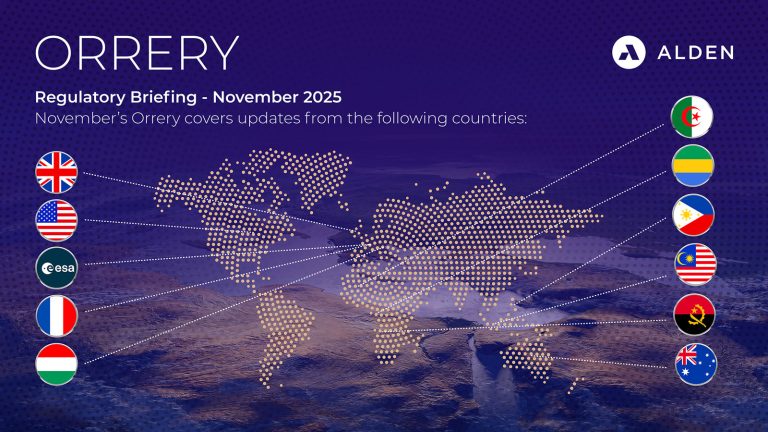
Alden Orrery – Regulatory Briefing – November 2025
EUROPE
European Space Agency
ESA Director General presents European Resilience from Space Programme
On 28 October 2025, European Space Agency (ESA) Director General, Josef Aschbacher, presented further details of the European Resilience from Space Programme, an optional ESA programme announced earlier in 2025 and set to open for subscriptions at the November 2025 ESA Ministerial Council.
The proposed programme is designed to integrate remote sensing, connectivity, PNT (positioning, navigation and timing), spectrum monitoring and Internet of Things (IoT) capabilities to support security-related and resilience-focused applications.
ESA to establish presence in Tokyo to strengthen strategic partnership with Japan
On 28 October 2025, ESA announced that it will establish a presence in Tokyo, marking ESA’s first presence in Asia. The decision builds on ESA’s longstanding partnership with Japan and the Japan Aerospace Exploration Agency (JAXA), and is intended to deepen cooperation across a broad range space activities.
Commenting on the announcement, Josef Aschbacher said: “Our relationship with Japan is built on decades of trust and scientific excellence. The establishment of an ESA presence in Japan signals our clear intention to elevate our cooperation with Japan across all domains of space – from Earth observation and planetary defence to science, human and robotic exploration and commercialisation. This will allow us to foster closer ties not only with JAXA but also with Japan’s dynamic and innovative space industry.”
United Kingdom
House of Lords publishes Space Economy Report
On 4 November 2025, the House of Lords UK Engagement with Space Committee published its report, “The Space Economy: Act Now or Lose Out”. The report highlights that the UK has the potential to play a significantly larger role in the rapidly evolving space economy and identifies several national strengths on which to build. To realise this potential, the report issues a set of key recommendations for Government action:
- provide a coherent strategic direction with clear delivery plans;
- focus on the development of multi-use technologies;
- ensure that structures of government are adequate to deliver cross-governmental space policy;
- reform the UK’s space funding model to allow firms to grow and scale;
- ensure the UK remains a world-leader in future space regulation;
- address skills challenges within the space sector;
- adopt a strategic approach to international partnerships; and
- promote space safety and sustainability on the international stage.
Read the full House of Lords report
The Nordic Council of Ministers
Nordic Ministers sign joint declaration on space cooperation
On 28 October 2025, the Nordic Ministers of Economic Affairs and Regional Development met in Hanasaari Espoo, Finland, to sign a joint declaration aimed at deepening cooperation in the space sector. As part of this initiative, the Nordic countries – Denmark, Finland, Iceland, Norway and Sweden – are establishing the “Nordic Space Dialogue”, which will take the form of regular high-level roundtables.
While the Nordic countries already collaborate on space infrastructure through ESA and the EU Space Programme, the creation of a structured and recurring dialogue is intended to strengthen their collective voice in European and international fora. The initiative aims to enhance the quality and availability of space services in northern regions and to support the promotion of European space capabilities within the EU and ESA – particularly in relation to the Arctic and other northern areas.
France
France publishes National Space Strategy 2025-2040
On 12 November 2025, France’s General Secretariat for Defence and National Security published its National Space Strategy 2025-2040. Recognising the rapid growth and transformation of the space sector, it defines France’s priorities as guaranteeing autonomous and sustainable access to space, strengthening the competitiveness of the French space sector, ensuring the resilience of military capabilities, supporting research and exploration and promoting responsible international cooperation in the interest of European sovereignty.
Hungary
Hungary signs Artemis Accords
Hungary became the 57th state to sign the Artemis Accords, on 22 October 2025. The Artemis Accords are a US-led initiative to establish a common vision for countries looking to participate in NASA’s 21st-century lunar exploration plans.
Commenting on the signature, NASA Acting Administrator, Sean Duffy, said: “[Hungary’s] decision to join the Artemis Accords affirms a shared commitment to peaceful, transparent exploration – at a time when others seek to weaponise the final frontier.”
AFRICA
Algeria
Algeria lays foundations for its Space Communications Centre
On 15 November 2025, Algeria’s Minister of Posts and Wire and Wireless Transport, Said Ali Zorouqi, laid the foundation stone for the new Algeria Space Communications Centre in Bogzol, Al-Madiya.
The US$7.7 million investment marks a significant step toward enhancing the capacity and long-term sustainability of Algeria’s satellite communications services and demonstrates the country’s commitment to strengthening the resilience of its national space communications architecture.
Angola
Angola establishes the Angolan Space Agency
On 15 October 2025, the President of Angola, João Lourenço, announced the creation of the Angolan Space Agency.
The new Agency will serve as Angola’s central authority for space affairs, tasked with overseeing the development of modern and resilient space infrastructure, ensuring Angola’s peaceful use of outer space, and strengthening Angola’s role and presence in the space domain.
Gabon
Gabon and China sign Memorandum of Understanding on Earth observation
The Gabonese Agency for Space Studies and Observations (AGEOS) and China’s Land Satellite Remote Sensing Application Centre (LASAC) signed a Memorandum of Understanding (MoU) during the China–Africa Cooperation Centre on Satellite Remote Sensing Application (CASCA) Week 2025, held from 20-24 October 2025.
The MoU aims to strengthen Gabon’s Earth observation (EO) capabilities. Under the agreement, Gabon will receive daily access to high-resolution satellite imagery from LASAC, significantly improving national capacity for territorial surveillance, environmental management and sustainable economic planning.
NORTH AMERICA
United States
FCC launches new rulemakings to modernise US Satellite Licensing Framework
The Federal Communications Commission (FCC) voted on 28 October 2025 to launch two new rulemaking proceedings on US satellite licensing.
The first proposes a “licensing assembly line” intended to accelerate application processing and enhance predictability and flexibility for applicants. It would establish bright-line criteria for applications that clearly serve the public interest.
The second proceeding aims to promote more intensive use of the upper microwave spectrum bands and improve the efficiency of associated licensing processes.
Commenting on the proposed reforms, FCC Chairman, Brendan Carr, stated: “We propose to replace our legacy ‘default to no’ mindset with a ‘default to yes’ framework, built on permissionless innovation.”
ASIA
Malaysia and the Philippines
Malaysia and the Philippines sign Artemis Accords
On 22 October 2025, it was announced that Malaysia and the Philippines had signed the Artemis Accords, bringing the total number of signatories to 59.
The announcements were made during US President Trump’s visit to Kuala Lumpur for the annual ASEAN Summit. By signing the Accords, both countries reaffirm their commitment to responsible behaviour in outer space and to the peaceful, transparent and sustainable exploration of the Moon, Mars and beyond.
OCEANIA
Australia
Australia Endorses European Cooperation for Space Standardization
On 24 October 2025, Australia announced its official endorsement of the European Cooperation for Space Standardization (ECSS) for use in domestic space projects. This decision aligns Australia with internationally recognised standards that support innovation and facilitate deeper global collaboration.
By adopting ECSS standards, Australia reinforces its commitment to safe, sustainable and globally interoperable space operations while enhancing its strategic position within the global space industry.
If you would like more information on any topics in this Orrery Regulatory Briefing, please contact orrery@wearealden.com.


