
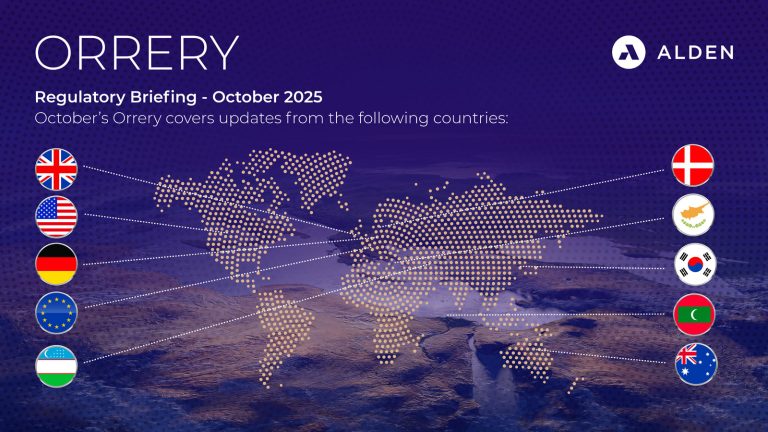
Alden Orrery – Regulatory Briefing – October 2025
EUROPE
European Union
European Union releases Defence Readiness Roadmap 2030
On 16 October 2025, Kaja Kallas, the High Representative for Foreign Affairs and Security Policy and Vice-President of the European Commission, presented the European Union (EU) Member States with the “Preserving Peace – Defence Readiness Roadmap 2030”.
The Roadmap introduces four initial flagship initiatives: the European Drone Defence Initiative; the Eastern Flank Watch; the European Air Shield; and the European Space Shield. Together, these initiatives aim to strengthen Europe’s capacity to deter and defend across land, air, sea, cyber and space domains, while contributing directly to NATO capability targets.
The Roadmap emphasises that defence readiness requires the development and acquisition of capabilities suited to modern warfare. It sets out clear objectives and milestones to close existing capability gaps, accelerate defence investments among Member States and guide the EU’s progress towards full defence readiness by 2030.
Cyprus
Cyprus joins European Space Agency as an Associate Member
It was announced on 23 October 2025 that the Republic of Cyprus has signed an Associate Agreement with the European Space Agency (ESA), under which Cyprus aims to achieve associate membership of ESA by early 2026. Associate membership will enable Cyprus to participate in ESA’s optional programmes, the Young Graduate Trainee (YGT) programme, Networking Partnership Initiatives (NPI) and research fellowship opportunities.
The Associate Agreement follows nearly a decade of cooperation between Cyprus and ESA, beginning with Cyprus’s accession as a European Cooperating State in 2017. Upon ratification, Cyprus will become the fourth active Associate Member State, alongside Latvia, Lithuania and Slovakia.
Denmark
Denmark invests 2.7 billion Danish Krone into space sector
On 20 October 2025, the Danish Ministry of Higher Education and Science announced that it will be investing 2.7 billion Danish Krone into the space sector to expand research, technology and European cooperation.
The investment follows Denmark’s national strategy for space exploration and innovation, which was released in November 2024. In particular, the Ministry noted participation in the ESA Launcher Challenge – an initiative focused on expanding European launch service supply and therefore ensuring greater robustness in Europe’s access to space.
Germany
Germany invests €35 billion into space capabilities
On 25 September 2025, Germany’s Defence Minister, Boris Pistorius, announced that Germany will invest €35 billion in its military space capabilities by 2030. The investment will focus on five main priorities: protecting against data disruptions and attacks; improved space situational awareness (SSA); enhancing resilience through several networked satellite constellations; secure launch capabilities; and a dedicated military satellite operations centre.
In a translated version of his speech, Pistorius said: “We are investing in protection, in resilience, in innovation. But we can’t do it alone… Let us work together to ensure that Germany and Europe remain strong and secure in space.”
United Kingdom
UKSA launches Wales Space Cluster Catalyst Fund
The UK Space Agency (UKSA) has announced the £247,000 Wales Space Cluster Catalyst Fund to support the growth of the Welsh space sector. The funding aims to advance the ambitions set out in ‘Wales: A Sustainable Space Nation’ – the Welsh space strategy published in 2022.
Commenting on the announcement, Antonia Yendell, Head of Space Ecosystem Development at the UKSA, said: “Wales is home to a dynamic and fast-growing space sector, and we’re proud to support its continued development through this targeted funding call.”
UKSA announces 23 new projects
On 30 September 2025, the UKSA announced £6.5 million in funding for 23 new space projects aimed at strengthening international partnerships, developing national capabilities and boosting economic growth. The funding is provided through the International Bilateral Fund (IBF) – a UKSA programme that supports ambitious collaborations between UK organisations and international space entities.
The 23 projects are diverse in scope, spanning activities from orbital threat detection to biotech manufacturing, and involve cooperation with partners in Australia, Canada, France, Germany, India, Japan, Lithuania and the United States.
UKSA publishes Corporate Plan 2025-26
On 30 September 2025, the UKSA published its Corporate Plan 2025–26, setting out the UKSA’s strategy, priorities and delivery framework for the year ahead within the UK Government’s broader space agenda.
The Plan introduces the UKSA’s new operating model, structured around three core components as follows.
- Themes – eight key segments of the space sector through which the UKSA delivers outcomes, including Exploration; Space Science; Telecommunications; Launch; In-Orbit Servicing, Assembly and Manufacturing (ISAM); Space Resilience; and Earth Observation;
- Threads – five cross-cutting areas such as innovation, investment and commercialisation; international partnerships; space sustainability; education and future workforce; and engagement with ESA; and
- Interventions – tools to drive change, including funding programmes, guidance and opportunities.
The Plan highlights that these Themes, Threads, and Interventions are designed to contribute directly to five overarching outcomes:
- Driving a high-growth economy through space;
- Fostering a more innovative space sector;
- Delivering benefits to citizens through improved space services;
- Enhancing national security; and
- Strengthening international partnerships.
UK and Australia renew Space Bridge
On 1 October 2025, the UKSA and the Australian Space Agency renewed their Space Bridge partnership, building on the initial framework established in 2021.
The Space Bridge is a bilateral framework agreement designed to strengthen collaboration, facilitate the exchange of expertise and create new opportunities across both nations’ space sectors.
Commenting on the renewed partnership, Dr Paul Bate, Chief Executive of the UKSA said: “The UK-Australia partnership is a priority for us, and the renewal of the Space Bridge is another step towards driving forward initiatives that deliver real benefits for life on Earth.”
UK and United States complete Rendezvous and Proximity Operation
On 18 September 2025, it was announced that the UK Space Command and the United States (US) Space Command conducted their first ever Rendezvous and Proximity Operation (RPO) between 4-12 September 2025. The RPO repositioned a US satellite to examine a UK satellite and assure the UK of its nominal operation in orbit.
Speaking on the accomplishment, Major General Paul Tedman, commander of the UK Space Command, said: “This operation was a first of its kind for UK Space Command and represents a significant increase in operational capability.”
NORTH AMERICA
United States
Federal Communications Commission releases Notice of Proposed Rulemaking to modernise space and Earth station licensing rules
On 7 October 2025, the Federal Communications Commission (FCC) released a Notice of Proposed Rulemaking aimed at overhauling and modernising the FCC’s space and Earth station licensing process. The proposal seeks to improve efficiency while providing greater predictability and flexibility for applicants. Key proposals include: creating an expedited licensing processing framework; adopting rules to better accommodate licensing of innovative and novel space activities; and requiring space station operators to share space situational awareness data.
ASIA
Maldives
Maldives Space Research Organisation signs Memorandum of Understanding with Axiom Space
The Maldives Space Research Organisation (MSRO) and Axiom Space announced on 30 September 2025 that they have signed a Memorandum of Understanding (MoU) to establish a world-class astronaut training programme, commercial spaceflight facility and collaborative space projects.
The MoU aims to leverage MSRO’s expertise in space science, research and technology, while drawing on Axiom Space’s experience in commercial human spaceflight missions to advance national and regional space capabilities.
South Korea
Innospace receives South Korea’s first commercial launch authorisation
South Korean launch startup Innospace announced on 19 October 2025 that the Korea AeroSpace Administration (KASA) had granted the company a commercial launch authorisation – the first ever issued to a private company in South Korea.
The authorisation represents the final approval required for the launch of Innospace’s Hanbit-Nano rocket, scheduled to take place from the Alcântara Space Center in Brazil between 28 October and 28 November 2025.
Uzbekistan
Uzbekistan signs Memorandum of Understanding with Amazon Project Kuiper
On 10 October 2025, the Ministry of Digital Technologies of the Republic of Uzbekistan announced the signing of an MoU with Amazon Kuiper Commercial Services LLC. The MoU sets out joint efforts to enhance telecommunications infrastructure and expand access to high-speed internet across Uzbekistan through Amazon’s Project Kuiper satellite network.
OCEANIA
Australia
Australia announces new partnerships with ESA and NASA
On 29 September 2025, Tim Ayres, Australia’s Minister for Industry and Innovation, and Minister for Science, announced two new international partnerships with ESA and NASA.
He outlined that the Australian Government has given a mandate to begin negotiations on a cooperative agreement with ESA which would establish a formal framework enabling Australian businesses and researchers to participate in ESA’s space science programmes and missions, while facilitating greater European activity in Australia.
The Minister also announced that a treaty-level Space Framework Agreement had been reached between Australia and the United States, paving the way for enhanced collaboration on joint projects with NASA and other American partners.
Australia sees inauguration of ESA deep space antenna
ESA inaugurated a new 35-metre-deep space antenna in New Norcia, Western Australia, on 4 October 2025. The facility becomes ESA’s fourth antenna within Estrack, ESA’s deep space tracking network. Known as ‘New Norcia 3’, the antenna will help meet ESA’s growing data transmission needs and strengthen Europe’s autonomy in space operations. Speaking at the inauguration, Josef Aschbacher, Director General of ESA, said: “This strategic investment reinforces ESA’s deep-space communication capabilities and maximises the return of our missions’ most valuable asset: data delivered from spacecraft voyaging far from Earth.”
Southern Launch and Varda Space Industries sign agreement for 20 further spacecraft returns to Australia
Southern Launch and Varda Space Industries signed a contract on 30 September 2025 to facilitate 20 spacecraft returns at the Koonibba Test Range in South Australia through to 2028.
The contract builds on the success of Varda Space Industries’ W-2 and W-3 missions, both conducted at Southern Launch’s Koonibba Test Range. Completed in February 2025, W-2 marked the world’s first commercial spacecraft landing at a commercial spaceport, followed just 10 weeks later by W-3, which achieved another successful return to the site.
If you would like more information on any topics in this Orrery Regulatory Briefing, please contact orrery@wearealden.com.


