
Alden Orrery – Regulatory Briefing – May 2025
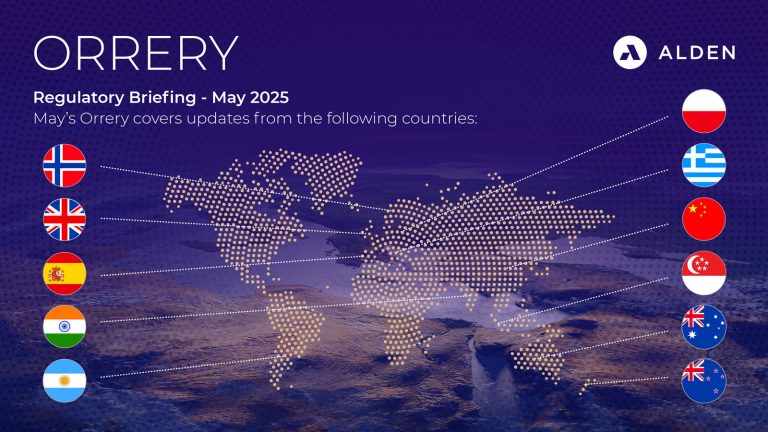
EUROPE
United Kingdom
UK Space Agency publishes Planetary Protection Technical Framework
On 8 May 2025, the UK Space Agency (UKSA) published its Planetary Protection Technical Framework, setting out technical guidance for the implementation of planetary protection requirements for lunar missions and missions beyond Earth orbit. The Framework applies to UK-licensed missions under the Outer Space Act 1986 and the Space Industry Act 2018.
The Framework aims to ensure that UK space activities protect both the Earth and the space environment from potential harmful contamination. By offering technical clarity, the Framework helps reduce regulatory uncertainty for both operators and regulators in meeting the UK’s planetary protection obligations.
The Framework is intended to be read alongside existing legislation and regulatory guidance, and is designed to support mission planning and licensing processes.
ClearSpace completes second phase of UK active debris-removal mission
On 7 May 2025, ClearSpace successfully completed Phase 2 of the CLEAR mission, marking a key milestone in the UK’s first Active Debris Removal (ADR) mission.
Key technical milestones achieved in this phase include:
- successful mechanical derisking of the spacecraft’s robotic capture system, confirming its ability to withstand harsh launch loads;
- validation of ClearSpace-developed image processing algorithms in a realistic environment, ensuring accurate detection and tracking of space debris;
- demonstration of close-proximity phases using a hardware-based spacecraft emulator, validating key operational sequences; and
- completion of detailed programme estimates, providing the UKSA with insights to support mission planning.
Speaking on the achievement, Rory Holmes, UK Managing Director at ClearSpace, said: “The CLEAR mission is more than just a debris removal project – it’s a stepping stone towards a fully operational UK-led in-orbit servicing capability. By demonstrating the capability to design, build, test, license, launch and operate this mission from the UK, we are proving that the UK has what it takes to lead in space sustainability.”
Greece
ICEYE strengthens presence in Greece
ICEYE, a global leader in synthetic aperture radar (SAR) satellite technology, announced on 16 May 2025 that it will open a new office in Athens, Greece. This marks a key step in ICEYE’s participation in the “Greek National Satellite Space Programme – Axis 1.2”, in collaboration with the Hellenic Space Agency and the Ministry of Digital Governance.
The new Athens facility includes a satellite assembly production line, supporting job creation in a growing high-tech sector. ICEYE’s expanded presence will also bolster the Greek space ecosystem through the transfer of SAR expertise and by attracting and developing local talent.
Commenting on the announcement, Rafal Modrzewski, CEO and Co-Founder of ICEYE, said: “We are very proud to commence operations in Greece, a strategic hub for ICEYE’s expansion in South-Eastern Europe. We look forward to strengthening our collaboration with the Greek space industry and accelerating its growth.”
Norway
Norway signs Artemis Accords
On 15 May, Norway became the 55th state to sign the Artemis Accords. The Artemis Accords are a US-led initiative to establish a common vision for countries looking to participate in NASA’s 21st-century lunar exploration plans.
Commenting on the signing, Cecilie Myrseth, Norway’s Minister for Trade and Industry, said: “This is an important step towards enabling Norway to contribute to broader international cooperation in ensuring the peaceful exploration and use of outer space.”
Poland
ICEYE to provide SAR satellites to Polish Armed Forces
On 14 May 2025, ICEYE signed an agreement with the Ministry of National Defence of the Republic of Poland to supply the Polish Armed Forces with an initial batch of three ICEYE SAR satellites, under the national MikroSAR programme. The agreement includes an option to procure an additional three satellites and expanded ground segment capabilities within the next 12 months.
As part of the agreement, ICEYE will also collaborate with local industry to deliver a mobile Intelligence, Surveillance and Reconnaissance (ISR) platform, enabling near real-time tasking, data acquisition and analysis.
Commenting on the agreement, Władysław Kosiniak-Kamysz, Deputy Prime Minister and Minister of Defence of the Republic of Poland, stated: “This is a great day for the Polish Armed Forces and Poland, because they are gaining full independence in radar reconnaissance and imaging. We are proud that a Pole founded a company like ICEYE. We are also certain that we are acquiring the absolute best capabilities in the world.”
Spain
Spanish Space Agency and European Space Agency confirm intent to collaborate on in-orbit demonstration mission
On 16 May 2025, the Spanish Space Agency (Agencia Espacial Española) and the European Space Agency (ESA) confirmed their intent to collaborate on the proposed CApTure Payload Bay (CAT) in-orbit demonstration mission.
As part of this cooperation, the agencies are considering the Spanish LUR-1 satellite as a candidate target for the mission. LUR-1 is equipped with the Mechanical Interface for Capture at End-of-life (MICE), which would enable its safe and timely removal from low Earth orbit at the end of its operational life.
The CAT mission will serve as a key in-orbit demonstration of a standardised docking interface, advancing European capabilities in active debris removal. This collaboration marks a significant milestone in the implementation of ESA’s Zero Debris Charter and demonstrates meaningful progress towards enhancing safety and sustainability in space.
ASIA
China
China issues new rules on Direct-to-Device Satellite Services
On 30 April 2025, seven Chinese government departments jointly issued the ‘Regulations on the Management of Terminal Equipment Directly Connected to Satellite Services’, establishing a legal and technical framework to support the development of direct-to-device (D2D) satellite services in line with national policy objectives.
According to the Chinese media, the regulations are intended to promote the healthy development of satellite-connected terminal services while safeguarding national security and public interests. Key provisions include requirements on:
- national security and legal oversight;
- data localisation and cross-border data controls; and
- frequency licensing and interference.
India
ESA and ISRO sign joint statement to advance human spaceflight cooperation
On 7 May 2025, it was announced that the Indian Space Research Organisation (ISRO) and ESA signed a Joint Statement of Intent to enhance cooperation in human space exploration, with a primary focus on low Earth orbit (LEO) and, in a secondary phase, on lunar exploration.
The statement also outlines plans to explore cooperation in:
- astronaut training;
- analogue missions (ground-based simulations of spaceflight operations); and
- parabolic flight activities.
The joint statement supports the use of common standards and is expected to pave the way for future joint research and utilisation activities in LEO.
Commenting on the agreement, ESA Director General Josef Aschbacher, stated: “The complexities and costs of space missions often surpass the capabilities of just one nation. In this context, partnerships have allowed us to achieve great milestones that would be unimaginable alone. ESA’s collaboration with international partners such as ISRO exemplifies the power of shared expertise and resources.”
Singapore
UNOOSA and Singapore partner for ‘Space Law for New Space Actors’ project
On 29 April 2025, the United Nations Office for Outer Space Affairs (UNOOSA) and Singapore’s national space office, the Office for Space Technology & Industry (OSTIn), announced a new collaboration under UNOOSA’s ‘Space Law for New Space Actors’ initiative.
As part of this cooperation, a Space Law Technical Advisory Mission (TAM) will be delivered to Singapore in October 2025. The mission will support the Government of Singapore in aligning its national space activities with international legal standards, helping to foster the responsible growth of its space sector. This initiative reflects the growing strategic importance of space activities for innovation, economic development and sustainability.
LATIN AMERICA
Argentina
Argentina adopts new general regulations for satellite services
On 8 April 2025, Argentina’s Secretariat of Innovation, Science and Technology published Resolution 58/2025, adopting new General Regulations for the Management and Provision of Satellite Services. The regulations repeal provisions from Resolutions 2325/1997 and 3609/1999 of the former Secretariat of Communications.
The regulations govern the provision of satellite facilities and services – including geostationary and non-geostationary satellites – within Argentina.
It applies to services operating in frequency bands allocated to the Fixed Satellite Service (FSS), Mobile Satellite Service (MSS) and Broadcasting Satellite Service (BSS), in line with the provisions of the Radio Regulations of the International Telecommunication Union (ITU) and the Table of Frequency Band Allocations of the Argentine Republic (CABFRA).
The regulation aims to streamline, optimise and increase transparency in the administrative processes related to satellite authorisations.
In addition, on 23 April 2025, the Argentine Communications Agency issued Resolution 608/2025, which establishes that applicants must pay an annual fee of an amount equivalent to USD 10,000 for registering any satellite system operating in Argentina.
OCEANIA
Australia
Varda successfully lands W-3 re-entry capsule in South Australia
On 13 May 2025, Varda Space Industries successfully landed its W-3 re-entry capsule at the Koonibba Test Range in South Australia, operated by Southern Launch. The landing marks Varda’s third successful space capsule return mission.
The W-3 mission was focused on data collection for military hypersonic research, carrying an inertial measurement unit (IMU) developed by Innovative Scientific Solutions Incorporated (ISSI) for the United States Air Force.
Commenting on the landing, Dave McFarland, Vice President of Hypersonic and Re-entry Test at Varda, stated: “The W-3 mission will provide unprecedented data to advance next-generation space and defence capabilities and continue to provide hypersonic environments to the re-entry test community.”
New Zealand
Rocket Lab launches radar imaging satellite for Japan’s iQPS
On 17 May 2025, Rocket Lab successfully launched its Electron rocket from Launch Complex 1 in New Zealand, carrying the latest satellite in a constellation of SAR imaging satellites developed by the Institute for Q-shu Pioneers of Space (iQPS), a Japanese aerospace company.
This launch is part of a broader contract between iQPS and Rocket Lab, which includes six additional Electron missions, four scheduled for 2025 and two for 2026. Rocket Lab has confirmed that the next launch is planned for June 2025.
Commenting on the mission, Shunsuke Onishi, CEO of iQPS, said: “With more Electron launches ahead, we’re more committed than ever to accelerating the buildout of our satellite constellation, and we look forward to continuing this powerful partnership.”
New Zealand to establish New Space Squadron within its Air Force
The Royal New Zealand Air Force (RNZAF) has announced that it will create a new space squadron to reflect the growing importance of space in defence and international security. The unit will be established on 1 July 2025 and will start with 15 personnel.
Speaking on the announcement, Air Vice-Marshal Darryn Webb, Chief of the RNZAF, said: “A space squadron essentially just formalises the fact that space is here with us now. It’s going to be more and more important into the future, so let’s perhaps put a little bit of bricks and mortar around that and provide a mechanism to enhance that growth.”
If you would like more information on any topics in this Orrery Regulatory Briefing, please contact orrery@wearealden.com.


